
Mind How You Go
On paintings of edgelands, landscapes of power and powerlessness and what spaces have been left for us to imagine within. (Exhibition in London through Saturday 28 Feb.)

This is an essay written for catalogue accompanying the excellent group exhibition Mind How You Go, showing at Lion House Gallery in Twickenham, southwest London (click for map), and extended through this Saturday, 28th of February. Mind How You Go gathers eight painters’ small paintings of edgelands landscapes and raises questions about what kinds of landscapes inspire imaginings of ‘freedom’.
Don’t skip out on the recent podcasts including the most recent one, an interview with Katrina Navickas about commons, enclosure, wasteland and the English history of public space. More stuff coming Thursday.
Correspondence:
The green world of the edgelands
The question, as so often in this time of confusion and dread, is: what has been left to us?
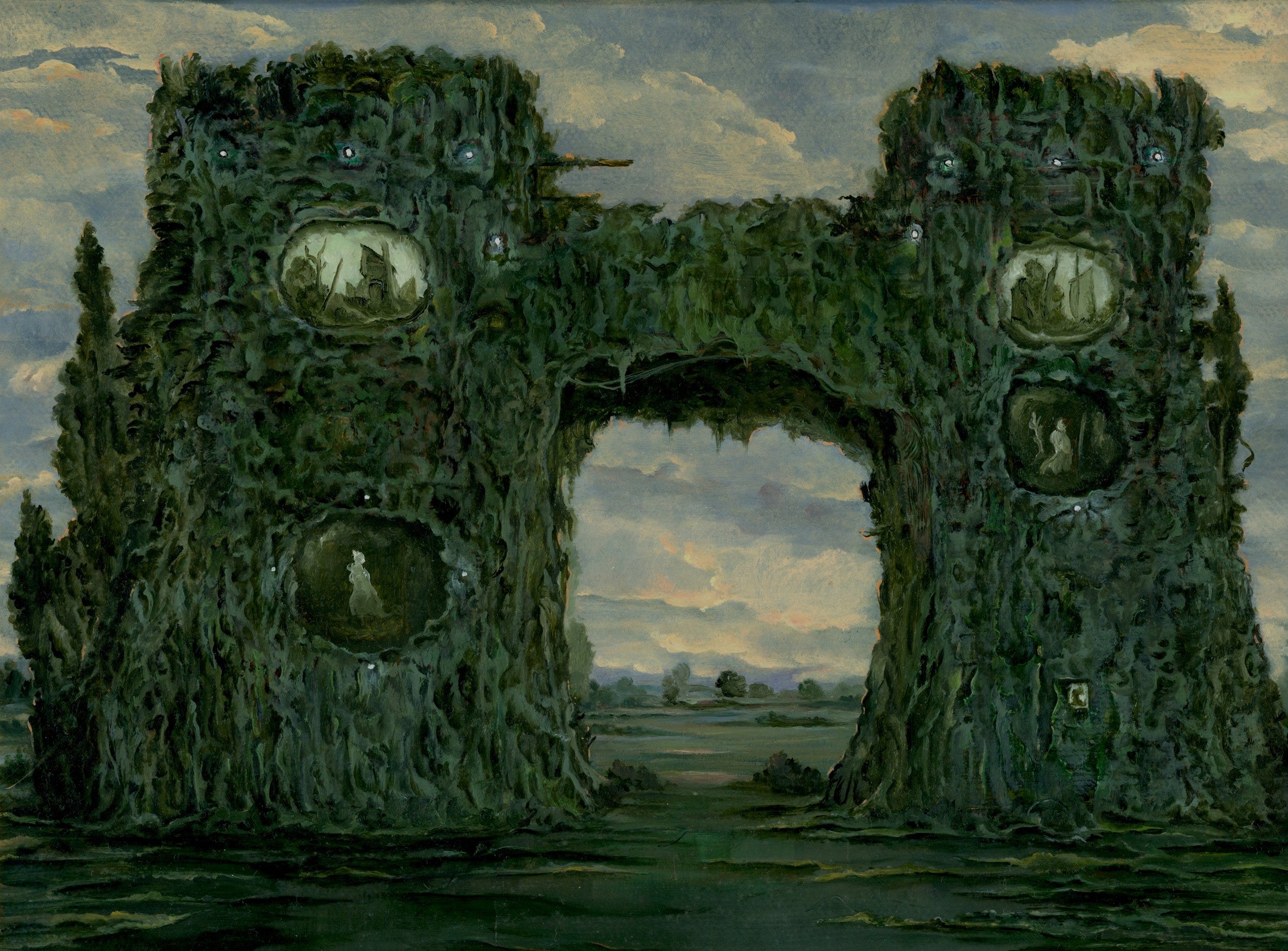
Here we have a ‘Gateway’, fecund with dark mossy wood, chaotic and imposing. Beyond it we can see the classic English lowlands and attendant Constable clouds. Here, too, we have warped images of graffiti-clad ruins, and brief moments of ghost signs and bricked-up storefronts. We have tiny landscapes, imposed upon tiny canvases, crowded by green and crowded by wood, as though just in viewing we must duck and weave to enter into them, invited or not. Mind how you go.
These are landscapes with power – immense power, indeed. But they are not landscapes of power. They are the landscapes left to us, the powerless – unstable, pregnant, dripping with anarchies of life.
Power is a proud landlord. When we see the gleam of a bank building or the crewcut lawn of a suburban half-acre, we know that there is a hand at work; a hand with good reason to conform and, in doing so, reap the benefits of the status quo. In the countryside, this action often mimics the hand-me-downs of the occluded wild: Capability Brown’s garden statements made with sweeping lawns and tidy clumps of trees, the stable ruin of a folly thrown in as a nod to the wildness of humans past, but as warning rather than tribute. There but for the grace of God …
In these landscapes of power – call that power capital or governance or church or whatever – we can see the signs of attention and intention. We humans have an evolutionary knack for spotting those signs: we walk through the metaphorical forest and see a footprint, a broken branch, a symbol carved in bark and it sends alarm-bell shivers through our blood. Sometimes we can be comforted by the knowledge that someone else is around. Sometimes finding the signs of that intention, but without human presence, is a warning that we’ve come to experience as eeriness or the uncanny.
Today, that crewcut lawn and tidy sweeping garden trigger this same sense of an invisible hand, but that invisible hand – that intention – reads as ‘ownership’. And for many people ownership means stability and stability means safety. The white picket fence, the fixed-up windows, the perfectly manicured lawn or tidy country path. It means assurance because everything is in its place.
But what if we turn that on its head? What if we were to see ‘orderly’ as ‘alarming’? As that footprint in the forest floor? And what if, instead, we found comfort in the chaos? What if, for some people, the invisible hand of ownership is the same as the haunting presence, the eerie trap, that triggers our internal human alarm bells? Where can these people find solace? Because there is pride among the powerless, too. The powerless have landscapes that swaddle and bleed and blaze with an unkempt fervour; scraps of ground that add up to something mighty.
These people - we - are scroungers of landscapes; we find beauty, calm, emotional sustenance where we can, for our landscapes are those which have been ignored, abandoned and deaccessioned by capital. We talk at length of ‘connection to nature’ yet are offered ‘nature’ as homeopathy, as though a pot plant or an office block’s front-desk green-wall tots up towards some daily recommended dose of vitamin green. How many nature points did you consume today?
In this year, proclaimed an anniversary for Britain’s two greatest painters of landscapes – Constable’s enclosed idyll; Turner’s imperial sea and sky – we the rest of us must wind back down to landscapes of tight moments. Flickers of light and corners of colour. Fecund gateways and abandoned swimming pools. Overgrown pathways and patches of hopeful flora wriggling between concrete and iron, all bursting from small canvases and fettering frames.
‘Mind How You Go’ indeed, for the landscapes we are left are too often a council-condoned one-metre strip between industrial fencing, riddled with the detritus of those who abandoned it. And yet, and yet, the artist, as always, finds a way. Finds a way to beauty.
The artists in ‘Mind How You Go’ return emphasis to these forgotten corners which the 21st century has so uncarefully left to us, the enclosed – places that are in an obvious state of becoming, while all else around acts as though it has become. The act of painting these places is a rebellion, conjuring beauty from that which we’re told is un-beautiful; a countryside equivalent to the Beatnik’s love of alleyways and dive bars.
All landscapes are unfixed, no matter what the hedge-trimming hand of power might tell us. Landscapes are not settled, but emergent. That which is public or private today was not that way a century or two back, nor will it be as time loops around. That which is ‘beautiful’ now will one day be seen as the stark ugliness of a past we can’t believe we allowed. That which is trimmed just right will grow again, wilder still.
The great British social anthropologist Tim Ingold describes our way of being with landscapes as ‘correspondence’ – that once we correspond with a landscape as an ever-emergent set of contexts, networks and stories, rather than ‘interact’ with it as a predetermined and pre-understood identity, we open up its in-between-ness and truly experience that landscape for the first time.
‘We are so used to taking a rearward view, to capturing things a moment too late, when they have already settled into the shapes and categories assigned to them … to correspond we need to go behind the scenes, to join with the creepers and move along with them in real time.’
Correspondence is about being with a place as part of its growing, as part of its ever-emergence, and to paint a landscape as a shifting rather than settled thing is to correspond with the world’s human and nonhuman and more-than-human objects all at once in a chaos that we might never be able to name.
And yet name it we have, because we’re human beings after all and naming is part of our DNA: we call this state of being ‘edgelands’, the catch-all for liminal spaces in which becoming is the norm and finality a dirty word.
‘Mind How You Go’ is an exhibition of edgelands landscapes as spaces of correspondence, rather than of interaction or interrogation. The emphasis is on finding a kind of landscape that we might feel comfortable not just in but with; not in spite but because of its subtle uncanniness, its demand for patience, its unstable narrative.
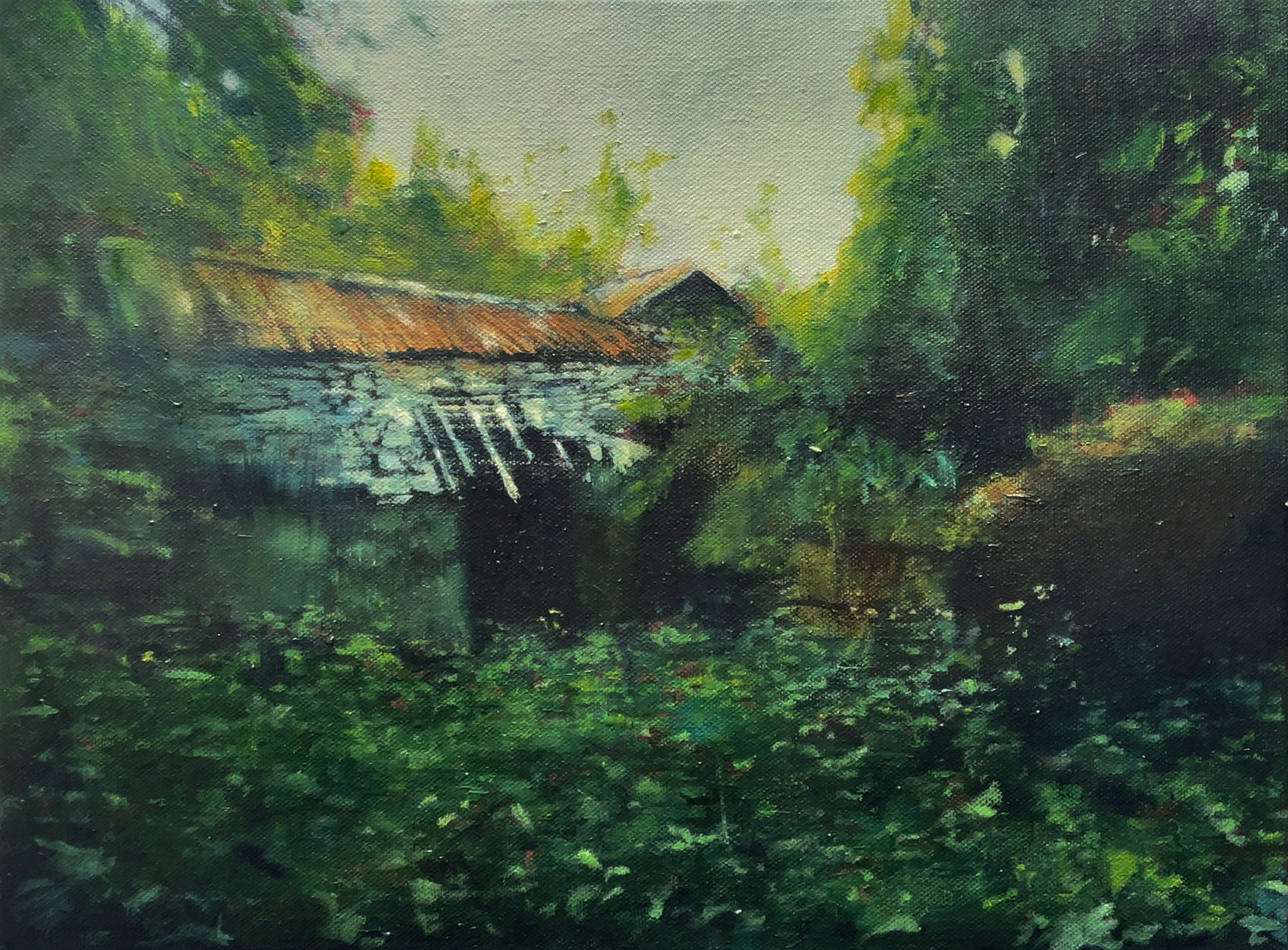
For many of these painters, the subject is that eerie intention – one not of ownership, but of a time just passed; the correspondence of ruins. Paul Smith’s abandoned swimming pools and collapsing farm outbuildings are being swallowed by nature’s becoming, a correspondence over decades that creates canvases in which the human and the nonhuman are merging rapidly. Likewise, in Joanna Whittle’s works like ‘Gateway (Kippfiguren, Just Judges)’ a Lovecraftian gate offers us a glimpse of the static security of a ‘normal’ landscape on the other side of its swallowing maw. Juliette Losq twists her canvases into warped shapes much like the twisted wreckage within them; human-made objects graffitied with texts, sinking into the forest.
In these works we’re given a taste of places that might seem foreboding or forbidden – like we’ve stumbled upon that clearing and found the signs we most feared. But these paintings might also be shibboleths – passwords that prove our allegiance to the forgotten places, and bring us closer to correspondence.
And there is the correspondence itself, paintings which are patient and vibrant; which inhabit and vindicate landscapes through material and colour. Lara Davis’s seascapes shimmer with forgotten glories, like a photograph taken by castaways on a lost island. There is no sign of the human here, except for the viewpoint of the painter. We are being led through the shimmer into some other place. Or in Hannah Brown’s paintings, pointedly all titled around or beside landscapes: ‘The Space by…’ and ‘Looking for…’ and ‘Study for…’, knowing that the real thing, the landscape itself, can never be captured as it never stops moving. Davis and Brown’s works, like many of the images in this exhibition, are defined by patience, by the slowed-down time of waiting for the perfect glisten on a leaf or a wave. Mandy Payne and Narbi Price paint urban spaces, devoid of humans, in bright tones that highlight that absence – as though the colour itself might ring out as a kind of uncanny intention. Gordon Dalton does similar with faded pastel and earth-tone mind-maps of Northeastern England landscapes: these are imagined landscapes that offer escape; a treasure-map cartography in which X marks the underground.
Like Shakespeare’s forests, edgelands serve as our century’s sites of resistance and transformation. As we follow along the paths traversed in these artworks, the ‘mind’ in ‘Mind How You Go’ changes meaning – from watch out, to consider, to the mind itself – being how ‘you’ go. We go into these spaces to correspond with landscapes of quiet revolution, in which instability and unmannered architectures – both natural and humanmade – give us our ‘green world’ in which we can recreate ourselves and our relationships to place, to people, to power.
What has been left to us are the edgelands, and they are enough.
Justin Hopper is a writer and performer working at the intersection of landscape, memory and myth.
Wonderful read, Justin. This, particularly:
'We find beauty, calm, emotional sustenance where we can, for our landscapes are those which have been ignored, abandoned and deaccessioned by capital.'
Sublime. Exhibition sounds fabulous.
Crumbling swimming pools, structures distorted by entropy and abandonment... thank you for this delicious glimpse of imaginative riches! I shall be going there.